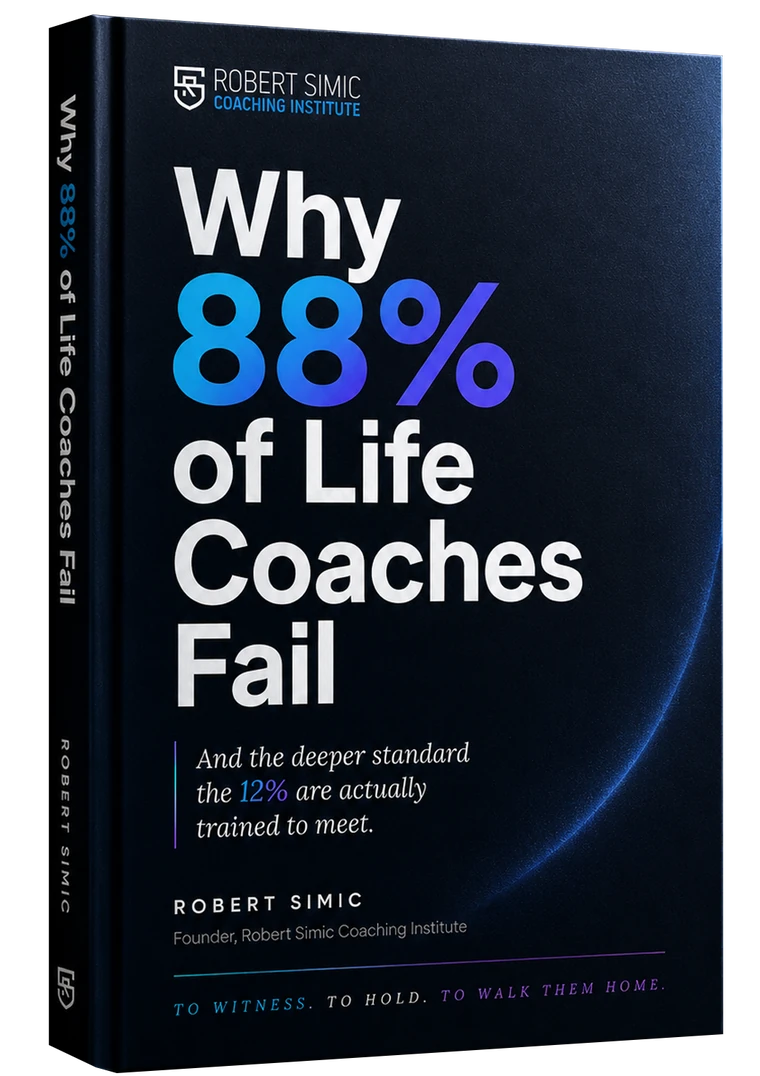
A note before you begin
This is not a sales pamphlet wearing the clothes of a book.
It is the honest thing I would have wanted to read before I spent the first ten years of my own career stacking certifications, attending the seminars, collecting the credentials, and slowly realising that none of them were teaching me what the work actually required.
I am the founder of the Robert Simic Coaching Institute. I have held more than fifty certifications across coaching, neurolinguistic work, hypnotherapy, and the deeper transformation modalities. I have trained directly inside the lineages of Richard Bandler, Tad James, Bob Proctor, and many others. I have spent two decades watching the coaching industry grow into the second-fastest-growing profession in the world, and watching most of the people who entered it leave it within three years.
This reading is for the practitioner inside you, the one who has felt for a while that the tools you have are too small for the room you keep walking into.
There is no pitch on these pages. There is a doorway at the end of them. The doorway is a conversation. We will get to it when we get there.
Read it slowly.
Chapter 1
The Number
Eighty-eight percent.
That is the share of life coaches who do not survive in the profession. Different sources put the number slightly differently. The International Coach Federation has cited variations of it. Industry surveys have hovered around it for over a decade. The exact percentage does not matter. The shape of the truth is what matters.
If you walked into any other profession with a survival rate like this, you would assume something was wrong with the training. With medicine, with law, with engineering, with any trade that builds a real craft, you would expect that the schools producing the graduates were either failing the students or selecting the wrong ones.
Coaching does neither, and yet the failure rate sits where it sits.
The reason the industry does not talk about this honestly is that the failure is usually translated as a business failure. The coach could not market themselves. The coach did not niche down. The coach failed at sales. The coach gave up too soon. The coach was not consistent on social media. There is a whole secondary industry built on selling the failed coach a way out of the business problem they were told they had.
The business problem is mostly a symptom.
The deeper truth is harder to say out loud because everyone in the chain has an interest in not saying it. The truth is that most coaches are not trained for the work. They are trained around it. They graduate with frameworks, scripts, evaluation rubrics, and a certificate, and they sit down in front of their first paying client and discover that what the client actually needs from them is something the training never built.
The client needed a witness. The training gave them a framework.
The client needed a seat that did not flinch when something heavy arrived in the room. The training gave them a list of powerful questions.
The client needed someone who could stay with them while their identity reorganised in front of both of them. The training gave them a goal-setting worksheet and a competency rubric.
The gap is real. The graduates feel it. They start to suspect they are not good enough at this, when the more honest answer is that they were not actually trained for this. They were trained for the version of coaching the industry could productise. The version the room actually needs was left out of the curriculum.
Eighty-eight percent.
The number is not about marketing. It is about a profession that mistook the technique for the work.
Chapter 2
What you were trained for
If you have already trained somewhere, you know the pattern.
You sat through modules on active listening. You learned the four phases of a coaching conversation. You learned about open questions and closed questions. You learned about powerful questions and the kinds of powerful questions that earn extra points on a certification evaluation. You learned about goal-setting frameworks, accountability structures, the wheel of life, the GROW model, the SMART model, the wheel-of-everything model. You may have learned about NLP fundamentals. You may have learned about hypnotherapy or breathwork or somatic work. You may have collected several certifications, each one promising the next layer of depth.
You were taught technique. You were taught structure. You were taught how to run a session that satisfies an external evaluator.
There is nothing wrong with any of this. The frameworks work for what they were designed to work for. The certifications signal a baseline. The competencies, when honestly applied, do produce a basic floor of professional conduct.
The trouble is that none of this teaches the seat.
The seat is the trained capacity to sit with what arrives in the room without flinching, fixing, or rushing. It is the practitioner's nervous system, calibrated over time, that can hold the weight of a client's actual material without either taking it on or pushing it away. It is the precision in timing, the silence held a beat longer than is comfortable, the quality of attention that lets the work happen without the practitioner needing to manufacture it.
You cannot read it off a slide. You cannot study it from a textbook. You cannot pass a written exam on it. It is built only one way. Through hours, alongside someone who already has it, with feedback that is honest enough to hurt and gentle enough to receive.
This is not how most coaching schools train.
Most coaching schools train the way the modern business of education trains. Modules you can move through on your own time. Group coaching calls you can dial into. Practice triads with peers who do not yet have the seat themselves. Recorded sessions evaluated by people working from a checklist. A path designed to scale, to produce graduates, to be priced and resold.
It is a business model first and a vocation second. The business model is honest about what it offers. The graduates are sometimes not honest about what they received.
If you have been through one or more of these programmes, you may already know the gap I am describing. The certificate is on your wall. The first paying client is in front of you. The gap is the space between what you were trained to perform and what they came in here to be met with.
Chapter 3
What the room actually asked for
There is a moment in nearly every session that the framework does not survive.
The client says the thing they did not plan to say. The grief arrives that they came in pretending was not there. The story they have told a hundred times in their head finally lands on the floor in front of you. The room goes quiet in a way the agenda did not predict.
In that moment, the framework you were trained on becomes louder, not quieter, in your head. The voice inside you reaches for the next question on the model. What would a successful outcome look like? On a scale of one to ten, where are you? What is one small step you could take this week? The questions are not wrong. They are simply too small for the moment.
What the moment is asking for is not a question.
It is asking for a witness. It is asking for someone who can stay in the room without scrambling to make the moment easier for themselves. It is asking for a presence that is not performing presence. It is asking for the kind of attention that allows the client to feel met for the first time in a long time, possibly for the first time at all.
The seat is what makes this possible.
The seat is what is missing when the trained coach feels themselves go small in the moment. They reach for the technique because the technique is what they were given. They do not have the trained nervous system that knows how to hold what is in the room without taking it on. The training did not build that part of them. They are trying to do, in the moment, what their preparation never trained them for.
The client feels it.
They do not always have the language for what they felt. They will say the session was helpful. They will fill out a positive evaluation. They will come back, sometimes, for another round. And the practitioner inside the coach will know, with a quiet and accurate ache, that the session did not do what it could have done.
The client got the framework. They came in for the witness.
This is the deepest reason eighty-eight percent of life coaches fail. Not the marketing. Not the niching. Not the price ladder. The deepest reason is that the work the room asked for and the work the school trained for were two different things, and the gap between the two slowly drains the practitioner until they leave the profession.
Chapter 4
The seat the credential cannot certify
I am going to say something here that the industry would rather I did not say.
Most accreditation in the coaching world is not what it presents itself to be.
The International Coach Federation, the ICF, does a real job. The framework around its core competencies is genuinely useful as a baseline structure. The credential opens doors in markets that take coaching seriously. I respect the work the ICF has done over the years to professionalise this industry, and the Robert Simic Coaching Institute is accredited under the ICF framework at both the ACC and the PCC level. We comply with the standard. We submit to the audits. We honour the competencies. We do this because the practitioner market reasonably expects it, and because the framework, at its baseline, has real value.
I will also tell you, plainly, what the ICF cannot do.
It cannot certify the seat.
No accrediting body in this industry can. No credential, no badge, no logo on a website can measure whether the graduate can actually sit with a client in pain and stay steady. None of them can evaluate the trained nervous system, the precision in timing, the silence held a beat longer than is comfortable. They were not built to. They were built to evaluate competencies, hours, and structural compliance. They do that job. The deeper job is left to the institute.
Most institutes do not do the deeper job. Most institutes do exactly what the credential asks of them and stop there.
I will also tell you, plainly, about the other accrediting bodies that fill the space outside the ICF. The neurolinguistic field alone has dozens of self-administered bodies, most of them websites with annual invoices, each one accrediting the institute that registers with them and collecting the fee. The Robert Simic Coaching Institute is accredited at the foundation level by one of these bodies, the Federation of NLP Coaching Professionals. I will not pretend the accreditation does what it does not do. We hold it because the practitioner market expects it. We never lean on it as the validator of what we actually train for.
The credential is a baseline. The seat is the work.
The honest framing for any prospective practitioner is this. The credential is a baseline. The seat is the work. The institute that confuses the two will produce graduates who hold the credential and lack the work. The institute that knows the difference will produce graduates who hold both. There are not many institutes in the second category.
This is not a problem the industry will solve by adding more credentials. It will only be solved by training the seat. That is a different kind of work. That is the work I built RSCI to do.
Chapter 5
The two movements
Strip away every framework you have been taught, and the actual work that happens in a real session has a shape.
It has two movements.
The first movement is the client setting down what is not theirs to carry.
The performances. The strategies. The inherited stories about who they were supposed to be. The version of themselves that they constructed in childhood to stay safe, to stay loved, to stay close to the people they needed. The carrying that started as a survival skill and stayed as an identity. The contracts the client signed without knowing they were signing them.
I call this movement Unbecoming. It is subtractive. It does not add a single new technique to the client. It helps them set down what was never theirs in the first place.
The second movement is the client recognising what is still there underneath.
The version of them that was never broken. The self that did not need to be earned, performed, or proven. The clarity, the steadiness, the warmth, the will, the knowing, that was buried under the performance for so long that they forgot it was there. They do not need to learn it. It is already in them. They need to remember it.
I call this movement Remembering. It is the homecoming. It is what the work is for.
Movement 1
Unbecoming
The client sets down what is not theirs to carry. The performances. The inherited stories. The contracts signed without knowing they were signed. It is subtractive. It does not add a new technique. It helps them set down what was never theirs in the first place.
Movement 2
Remembering
The client recognises what is still there underneath. The self that did not need to be earned, performed, or proven. The clarity, the steadiness, the warmth, the will. They do not learn it. They remember it. It is the homecoming.
These two movements are the entire architecture of a real session. The framework can come and go. The technique can arrive when it is useful. The model can structure the agenda. The actual work is happening at this level, beneath all of it.
A practitioner who has been trained for this can run the two movements without needing the script. They feel where the client is in the arc. They know what the moment is asking for. They do not have to consult the model in their head to know whether to speak or stay quiet. The training has built the reflex.
A practitioner who has not been trained for this can run a clean technical session that does not produce these two movements at all. The client leaves with a goal-setting worksheet and the same weight on their chest as when they arrived.
The eighty-eight percent live in that second sentence. The twelve percent live in the first.
Chapter 6
The three capacities
If the two movements are the work, the three capacities are the trained practitioner who facilitates it.
To witness.
This is the first capacity. The trained ability to receive what arrives in the room without interpreting it through your own unresolved material, without rushing to make sense of it, without reaching for the technique. You sit and you let the client be seen. You do not project your own healing onto theirs. You do not script the meaning of their story for them. You witness. The room expands when you do.
To hold.
This is the second capacity. The trained ability to contain what you witness. Not solve it. Not soothe it. Contain it. The client feels the presence of a steady seat across from them, and that steadiness becomes the structural support that lets them feel what they have been working hard not to feel.
The practitioner's calm is not performed. It is built. You cannot hold the room with a nervous system that has not been held first. You cannot witness a client's contract while you are still inside your own. You cannot walk someone home if you have not yet found the door.
This is the deepest reason the hold is the most undertrained capacity in the entire profession. Almost no institute asks the practitioner to do their own first-order work before they are released to do the work for others. The graduate is certified before they are resolved. They sit in front of a client with the same emotional weight, the same self-confidence questions, the same “not good enough” loop the client is walking in with. The hold is not possible from there.
To walk them home.
This is the third capacity. The trained ability to accompany the client back to themselves. Not lead them. Not push them. Walk alongside them. The client moves at their own pace through the Unbecoming and the Remembering, and the practitioner is the one who is there beside them, present, paced with their nervous system, available for the moment of recognition when it arrives. You are not the destination. You are the company on the road home.
Three sacred verbs. Three trained capacities. One body of work.
When I say a practitioner is trained for the work, I mean they have been built in these three capacities over time. They have been supervised. They have done their own material. They have sat with master practitioners who already had the seat. They have been corrected and reshaped, gently, until the capacities are theirs and they do not have to think about which one to use. They are simply available in the moment the work asks for them.
This is not a weekend training. It is not a download. It is not a framework you memorise. It is the slow, deliberate building of a practitioner's nervous system over a defined period of time, under the eye of people who have done it themselves.
The twelve percent of life coaches who survive in this profession are largely the ones who have been trained for this, somewhere, somehow, by someone. Most of them did not get it from their initial certification. They found it later, from a teacher or a lineage or a supervisor who carried the seat and was willing to train them in it. They paid for it twice. They had to.
There is a kinder version of this story. It is the version where the practitioner is trained for the work in the first place. Where the initial certification is built around the seat, not around the framework. Where the graduate leaves with both the credential and the capacity. That is the version we built the Robert Simic Coaching Institute to deliver.
Chapter 7
What the 12% do differently
If you watch the twelve percent who survive in this profession for a few years, you start to see what they share.
They have been transformed by the work themselves, before they tried to deliver it to others. They have sat in the client seat for enough hours that they know what it actually feels like when the two movements happen in someone. They are not running a methodology from the outside. They have lived it.
They have lineage. Somewhere along the way, they apprenticed to someone who carried the work. They sat in supervision. They received correction. They were shaped by a practitioner who had been shaped by another practitioner before them. The work was passed down. It was not assembled out of online modules.
They have a methodology that survives contact with the room. The framework is not just a structure they perform for evaluators. It is a body of work that handles what real sessions throw at it. When the unplanned thing arrives, the methodology does not collapse. It accommodates.
They do their own work continuously. They do not consider themselves finished. They keep sitting with their own material, in supervision, in their own client seat, in honest conversation with other practitioners. The seat does not stay built. It is maintained by ongoing practice.
They are quietly selective about whom they train next. They do not believe that the way to honour the work is to ordain everyone who applies. They believe the way to honour the work is to train only the people whose call is real, whose capacity to be trained is real, and whose own work is far enough along that they can hold the room for someone else without leaking their own material into it.
This is not gatekeeping for the sake of exclusivity. It is the gate the work itself asks for. The trained practitioner takes on the responsibility of being in the seat for another human being. The institute that trains them takes on the responsibility of producing practitioners the seat can be trusted to.
This is the deeper standard the twelve percent are trained to meet. It is not new. It is the standard real practitioner traditions have always trained to meet. The coaching industry, in its scramble to scale, forgot it. The institutes that remember it are the institutes that produce the practitioners the world is short on.
Chapter 8
The Institute
I am going to tell you, briefly, what the Robert Simic Coaching Institute is.
It is the institute I built because I could not find an institute that did what the work required. I had been through the credentialing systems. I had collected the certifications. I had trained inside the lineages of the master practitioners of my generation. And when I started training other practitioners, I realised the existing institutional architecture would not produce the kind of graduate I knew the work needed.
So I built one.
RSCI runs four certification pathways. Two of them are accredited by the Federation of NLP Coaching Professionals. Two of them are accredited by the International Coach Federation, at the ACC and PCC levels. The credentials are real. We comply with the frameworks. We honour the standards each accrediting body asks us to honour.
Underneath the credentials, we train against an internal standard the accreditation does not measure. The standard is the three capacities. The graduate leaves with a credential the world recognises and with the seat the credential cannot certify. Both arrive together.
The practitioner is transformed before the practitioner is trained.
There is a principle underneath the training, and it is the principle that produces the trained seat in the graduate. Every RSCI pathway sequences inner work before outer practice. The cohort surfaces your own unresolved material. The methodology cleans the contracts you have been carrying, the self-confidence loops, the “not good enough” identity you may have walked in with. The supervision catches what would otherwise leak into your sessions with clients. By the time you graduate, the room you walk into is one you have already been held inside. This is not a bonus. It is the foundation. We call it the Inner Work First Principle, and it is the standard of every cohort. We do not bend on it.
The training is cohort-based. The online portions move at the practitioner's rhythm. The live portions are dated, time-boxed, and held with the cohort under direct supervision. The two Level 2 pathways, RSCI Level 2 and ICF PCC, include the full 5-Day RS Method Experience in Dubai as a core component, not as an add-on. The practitioner sits inside the room where the methodology runs at full intensity, and integrates what they witness into their own developing practice.
The team in the room is not just me. RSCI runs alongside a network of RS Method Master Coaches, senior practitioners I have trained over the years and who now hold supervision, mentor coaching, and direct work with the cohort. Practitioner training at the standard the work requires cannot happen without supervised time, and supervision cannot happen well without trained supervisors. The team is the quiet differentiator.
We never publish training pricing on the public site. The investment is discussed inside a free conversation with Sara, one of the veteran RS Method Master Coaches, in the context of the right pathway for the practitioner asking. This is not a sales tactic. It is the recognition that a meaningful conversation about your training cannot happen with a price tag in front of you. The number arrives when the pathway is the right one.
If anything in this reading has landed in you, the next step is that conversation.
Chapter 9
What happens next
The Apply page on the Robert Simic Coaching Institute website is the door I would like you to walk through.
It is not a sales page. It is not a discovery call form. It is the entry into a free, thirty to forty-five minute Zoom conversation with Sara, who has worked alongside me for years and has met thousands of practitioners arriving at the exact moment you are arriving at now.
What the conversation covers.
Sara will listen to where you are in your craft, what you have already trained in, what the call inside you is asking for, and what your market and your life context can hold right now. She will help you understand which of the four RSCI pathways fits the practice you are building. She will tell you, honestly, if the timing is not yet yours, or if a softer doorway is the right next step.
There is no pitch on that call. There never has been.
If RSCI is not the right institute for you, Sara will say so directly and we will send you with care. If you are the kind of practitioner the work was made to be trained in, the conversation will surface the right pathway, the right cohort, and the right investment, in the right context. Most applicants take a week to sit with the decision before they enrol. Some take longer. Some say no, and we keep the door open for the version of them that may show up again later. All of it is honoured.
If you would rather meet the work as a client first before deciding whether to be trained in it, that door is also open. The RS Method itself runs at rs-method.com. You can experience the work in your own seat before considering whether to train in it for others. Many of our strongest practitioners arrived this way. There is no rush.
And if neither doorway is the right one today, that is honoured too. This reading is yours to keep. The work is here when you are ready to come back.
A closing word
If you have read all the way to here, I am glad we met on these pages.
You did not have to read this carefully. You did. That tells me something true about the practitioner inside you. The call is there. The discernment is there. The willingness to sit with a hard reading before you act is there. These are the qualities the trained seat is built on.
Whatever you do next, do this much.
Do not settle for being trained around the work. Do not collect another certificate that the room will outgrow in your first paying session. If something in you is asking to do this work at the level the work actually asks for, find the institute that trains for that level. There are not many of them. The Robert Simic Coaching Institute is one of them. There are others, and I hope you find one if ours is not the right fit.
The world does not need more coaches who can run a framework. The world needs practitioners who can witness, hold, and walk people home.
There is a global shortage of them. The shortage is filled, one practitioner at a time, by institutes that train for the seat. Yours is one of the seats the world is waiting for.
From my heart to yours,
Robert “Aware” Simic
training the next generation